How 502,269 Reviews Predicted a $20B Market Cap Destruction

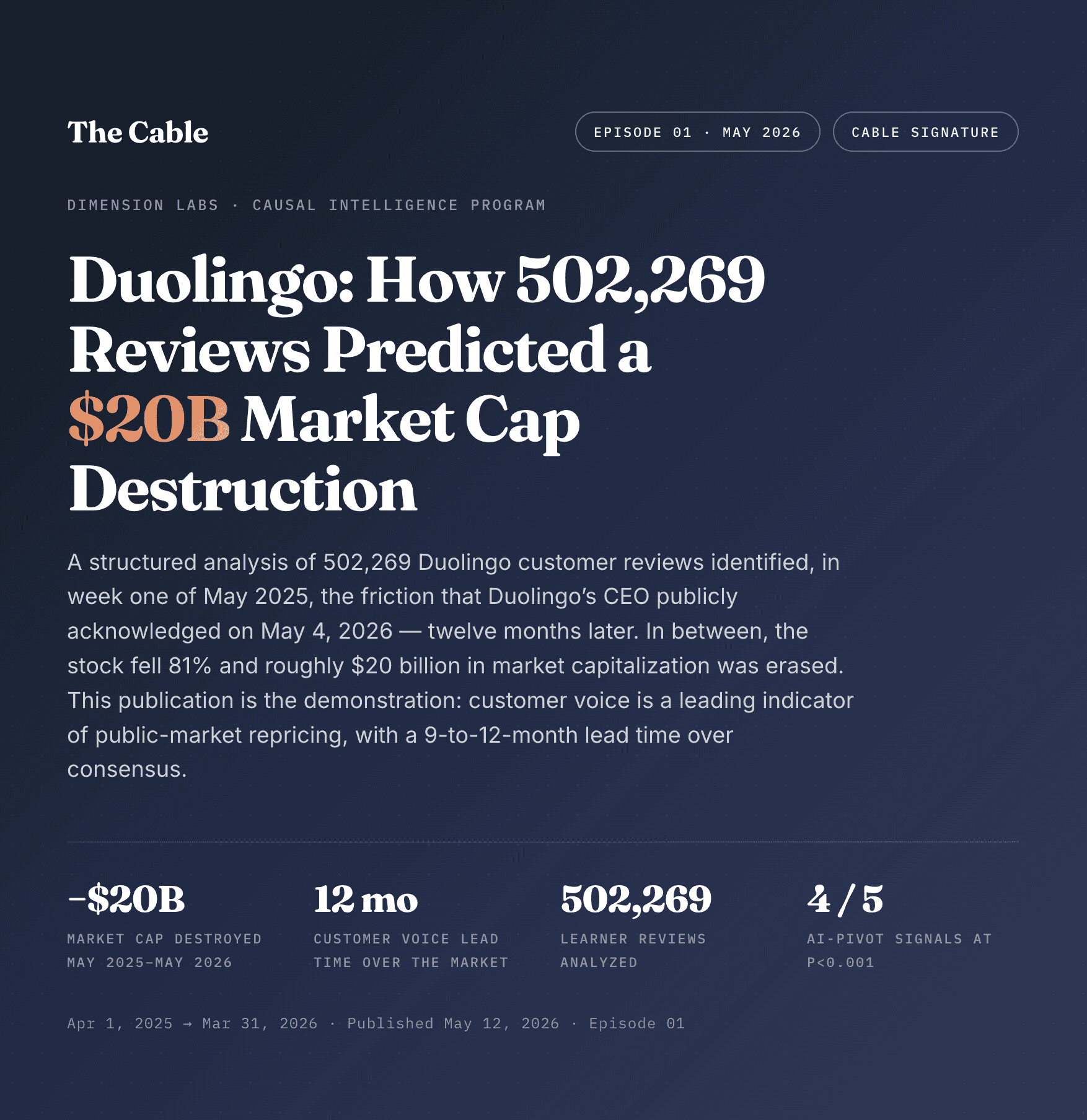
In week one of May 2025, a structured analysis of Duolingo customer reviews identified exactly the friction that Duolingo's CEO publicly acknowledged on May 4, 2026. In between those two dates, the stock fell 81% and roughly $20 billion in market capitalization was erased.
The customer voice had a 12-month lead time over the equity market's repricing.
This is what that analysis found — and what it means for every executive running a subscription business that has shipped an AI announcement in the last year.
Key takeaway: Customer voice is a leading indicator of financial performance with a 9–12 month lead time over quarterly SEC filings. The Duolingo case makes this concrete: the friction that destroyed $20B in market cap was visible in review data seven days after the event that caused it.
What Happened to Duolingo
Duolingo made two product decisions in 2025 that their customers rejected loudly — and their financials confirmed quietly, one quarter at a time.
Event 1: The AI-first memo (April 28, 2025)
Duolingo publicly announced it was going "AI-first," which customers read as: humans are out, quality is going down. The customer reaction was immediate and measurable.
Signal | Pre-pivot rate | Post-pivot rate | Significance |
|---|---|---|---|
AI mentioned in reviews | 0.72% | 4.53% | p < 0.001 |
Trust erosion | 0.27% | 3.71% | p < 0.001 |
Translator layoff reaction | 0.06% | 2.30% | p < 0.001 |
Course quality declined | 2.95% | 5.50% | p < 0.001 |
That spike wasn't a one-week blowup that normalized. Eleven months later, AI mentions in reviews were still running 2.18× above the pre-pivot baseline. The announcement landed as quality-control removal — and customers never fully forgave it.
Event 2: The Energy Points rollout (October 20, 2025)
Duolingo replaced its hearts mechanic with an energy system on the free tier. Customers interpreted it as a disguised paywall that interrupted learning mid-session. In the rollout week, 47.8% of Android reviews were 1 or 2 stars, up from 9.4% the prior week.
The dominant language in reviews was consistent: "can't finish a lesson," "running out of energy," "bring back hearts." That's not a feature complaint. That's a trust complaint.
The Financial Lag
Here's what makes this analytically striking. The customer voice signaled the problem in week one. The equity market needed four full quarters to price it in.
Quarter | DAU Growth YoY | Bookings Growth YoY | Customer Voice Context |
|---|---|---|---|
Q1 2025 | +49% | +38% | Pre-pivot baseline |
Q2 2025 | +40% | +41% | AI memo lands Apr 28; surface metrics still strong |
Q3 2025 | +36% | High | DAU growth decelerates; AI residual persists |
Q4 2025 | +30% | +24% | Energy launches Oct 20; bookings crater 17 points |
Q1 2026 | +21% | ~+10% | Management acknowledges "extra friction in monetization" |
The Q4 2025 bookings cliff — from +41% to +24% in a single quarter — is the single largest deceleration in Duolingo's public history. The customer voice had identified the underlying friction ten weeks earlier.
By May 2026, Duolingo's stock had fallen from $544.93 to $105.15. Management announced they were investing $50M+ in foregone bookings to roll back the friction. The customer data had been telling them this for a year.
Three Things This Proves
1. Customer voice leads financial metrics by 9–12 months
Quarterly filings are a lagging indicator. By the time a bookings deceleration shows up in a 10-Q, the underlying cause has been visible in customer language for multiple quarters. The gap between the two is where causal intelligence lives.
2. AI announcements carry a specific reputational risk
When a broad AI-first announcement lands, customers don't read it as "new features." They read it as "the humans are gone." The reviews make this explicit: "If I wanted to learn with an AI, I'd subscribe to ChatGPT." That substitution framing — general-purpose AI as the alternative — is the most expensive outcome. You've trained your own customers to leave your category.
3. Engagement mechanics that gate outcomes are a retention tax
There's a difference between a mechanic that limits access to a feature and a mechanic that interrupts the thing the customer came to do. Energy depleted mid-lesson isn't gamification — it's coercion. Once customers frame a mechanic as "money hungry" or "disguised paywall," every subsequent monetization surface inherits that framing. Trust eroded ahead of price language in the data by one to two quarters.
The Portable Diagnostic
This isn't a Duolingo story. It's a framework that applies to any subscription business that has shipped an AI announcement or changed an engagement mechanic in the last 12 months.
Three conditions made Duolingo uniquely exposed:
A broad AI announcement framed as "AI-first" rather than "we added AI to one specific workflow" — broad framings invite customers to compare you to general-purpose assistants
A mechanic that gates outcomes — energy depleting mid-lesson, not mid-feature
A parasocial brand relationship — customers who talk about your product like a person feel betrayed rather than disappointed
If all three conditions apply to your business, the diagnostic to run is straightforward:
Pull your customer voice — reviews, tickets, exit surveys — for a 90-day window before and after your last major product announcement
Design 15–20 structured dimensions covering the hypothesis: AI quality, trust, engagement mechanics, competitive substitution
Run pre/post statistical testing across the event boundary — look for the joint cliff where adverse sentiment and mechanism mentions (e.g., "AI," "energy," "paywall") move together in the same week
Measure the residual at 90 days — if AI or friction mentions are still running 2× above baseline, the announcement landed as quality removal
Overlay against your next two quarterly filings — if the pattern matches, you have a leading indicator system
The cost of running this analysis is rounding error compared to a single quarter of bookings deceleration.
What Causal Intelligence Makes Possible
Your dashboards show you the Q4 bookings cliff. They cannot tell you that the underlying cause was visible in customer language in May, six months earlier.
The distance between "our bookings decelerated" and "here's the specific friction event that caused it, with statistical evidence, dated to the week it happened" — that distance is the most expensive gap in enterprise analytics.
Dimension Labs closes it. We convert unstructured customer conversations into structured, queryable data — and join it with your CRM, billing, and product metrics. The result is intelligence that answers why, not just what.
The Duolingo case is a closed loop. Every finding in the customer voice was confirmed by SEC filings with a 9–12 month lag. The framework is portable to any consumer subscription business running AI features today.
Frequently Asked Questions
What do Duolingo reviews reveal about the impact of its AI pivot?
A structured analysis of 502,269 Duolingo reviews found that four of five AI-quality signals shifted significantly (p < 0.001) within seven days of the April 28, 2025 AI-first announcement. AI mentions jumped from 0.72% to 4.53% of reviews, and trust erosion spiked from 0.27% to 3.71%. Eleven months later, AI mentions were still running 2.18× above the pre-pivot baseline — indicating a permanent reputation shift, not a transient backlash.
How does customer voice data predict financial performance?
Customer language captures friction and trust erosion weeks to months before those dynamics appear in quarterly revenue or DAU metrics. In Duolingo's case, the customer voice identified the bookings-deceleration signal in week one of May 2025; the financial confirmation arrived through SEC filings across four subsequent quarters. That 9–12 month lead time is the actionable window for executives who want to course-correct before results deteriorate.
What is a "retention tax" in subscription products?
A retention tax is an engagement mechanic that interrupts the core outcome a customer paid for, rather than gating access to an additional feature. Duolingo's Energy system depleted mid-lesson — customers couldn't complete a practice session without watching ads or paying. Reviews characterized it as a "disguised paywall." The distinction matters because mechanics that gate outcomes produce trust language ("money hungry," "coercive") while mechanics that gate features produce value-comparison language — and trust language is significantly harder to recover from.
Does this analysis apply to B2B SaaS or only B2C subscription?
The underlying framework — joining unstructured customer language with structured business metrics and testing for causal relationships across event boundaries — applies to any business with customer conversations and measurable outcomes. The Duolingo case is B2C, but the same methodology has been applied to enterprise SaaS churn analysis, insurance policyholder interactions, and hardware product feedback. The specific three-condition risk profile (broad AI announcement + outcome-gating mechanic + parasocial brand) is most acute in consumer subscription, but the diagnostic approach is industry-agnostic.
To see what your customer conversations are telling you that your dashboards can't — book a demo with Dimension Labs.
Sources:
Dimension Labs, "The Cable Episode 01: How 502,269 Reviews Predicted a $20B Market Cap Destruction" (May 2026). dimensionlabs.ai
Duolingo, Inc., Form 10-K for Fiscal Year 2025. Filed February 2026. SEC EDGAR.
Duolingo, Inc., Q1 2026 Shareholder Letter. Filed May 4, 2026. ir.duolingo.com