Dimension Labs Research · 2026
The Question No One Can Answer
Every company tracks metrics. Revenue. Churn. NPS. CSAT. Retention by cohort.
And every quarter, someone in the room asks: "But why?"
Why did mid-market churn spike 18%? Why did NPS drop in enterprise? Why are partner-channel customers retaining at half the rate of direct?
The data team pulls up the dashboard. The numbers are there. The trend is clear. But the dashboard stops at what. It was never built to answer why.
So the room does what it always does. Someone reads 50 tickets. Someone asks CX for a "sentiment summary." Someone puts three anecdotes on a slide and calls it root cause analysis.
This is how most companies make their most important decisions: on a sample of a sample, filtered through interpretation, disconnected from the financial data that quantifies impact.
There is a name for the intelligence that is missing. We call it Causal Intelligence.
The Hierarchy of Business Intelligence
Not all intelligence is equal. Most of what companies have today sits at the bottom of a hierarchy they do not realize exists.
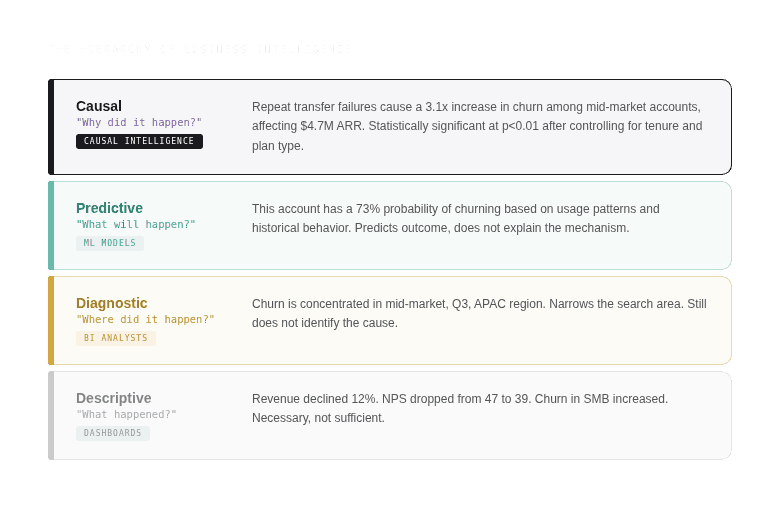
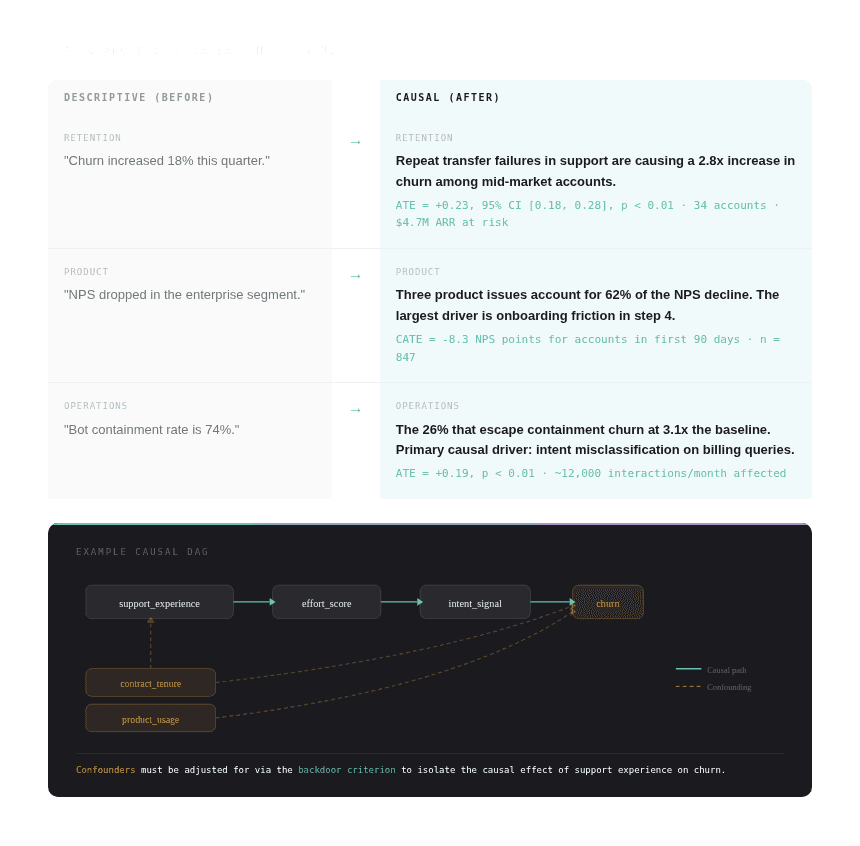
Descriptive. What happened? Revenue declined 12%. NPS dropped from 47 to 39. This is what dashboards provide. Necessary. Not sufficient.
Diagnostic. Where did it happen? Which segments, cohorts, geographies? This narrows the search. It still does not identify the cause.
Predictive. What will happen next? Based on usage patterns, this account has a 73% probability of churning. Useful, but opaque. You know that the customer will leave. You do not know why, which means you do not know what to do about it.
Causal. Why did it happen, and can you prove it? Customers who experience repeat transfers in support churn at 3.1x the baseline rate. This pattern is concentrated in mid-market, affects 34 active accounts representing $4.7M in ARR, and is statistically significant at p < 0.01 after controlling for plan type and tenure.
That is a fundamentally different category of answer. Specific, quantified, actionable. Until now, nearly impossible to produce at scale.
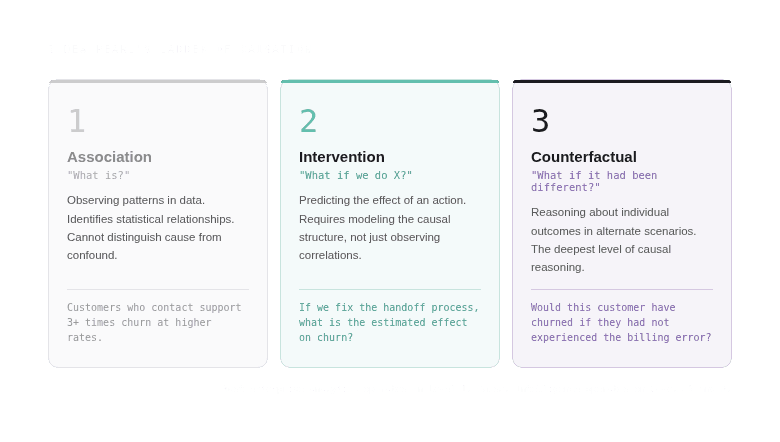
The computer scientist Judea Pearl formalized a related framework called the Ladder of Causation, which describes three levels of causal reasoning.
Level 1 is association: observing patterns.
Level 2 is intervention: predicting what happens if you take an action.
Level 3 is counterfactual: reasoning about what would have happened under different circumstances.
Most enterprise analytics operates entirely on Level 1. Causal Intelligence operates on Levels 2 and 3.
Why Causation Is So Hard
The reason companies are stuck at the descriptive level is structural, not intellectual.
Causal answers require two types of data working together: structured data (the metrics: revenue, churn, usage, NPS) and unstructured data (the explanations: what customers actually said in conversations, tickets, surveys, and emails).
Structured data tells you the score. Unstructured data tells you the story behind the score. You need both to establish causation.
These two datasets have never been connected. They live in different systems, different formats, different teams. Your CRM knows the customer churned on March 3rd. The support transcript from February 12th, where they said "I've called three times, keep getting transferred, and I'm evaluating your competitor," is sitting in Zendesk. Invisible to every analytics system in your company.
Traditional analytics operates entirely on the structured side. Traditional NLP operates entirely on the unstructured side. Neither crosses the gap.
The gap is where causation lives.
What Makes Intelligence Causal
Causal Intelligence requires three things that have never existed together in a single system.
1. Per-record structural enrichment.
Every conversation, not a sample, must be transformed from raw text into multiple structured fields. We call these fields Dimensions.
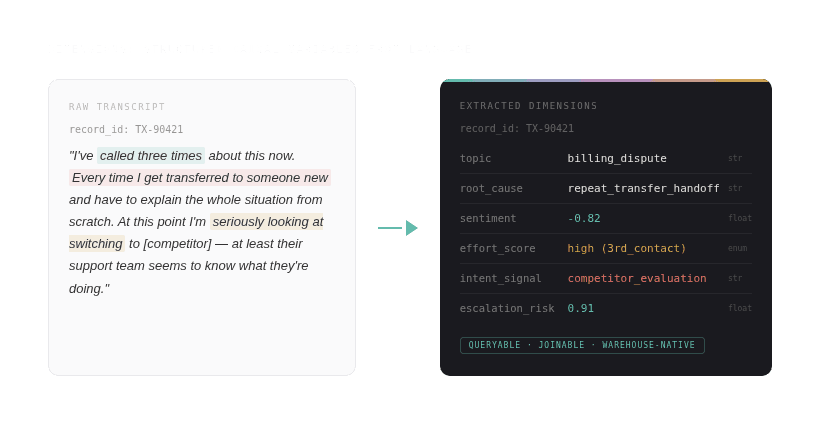
These are not tags. They are typed, queryable variables: str, float, enum. They populate columns in a schema. You can filter them, group by them, run SQL against them, and join them with any table in your warehouse. This is what turns a transcript into evidence.
2. The structured-unstructured join.
Enriched conversation data must be joined with the customer's structured business data. This is the step that makes everything causal.
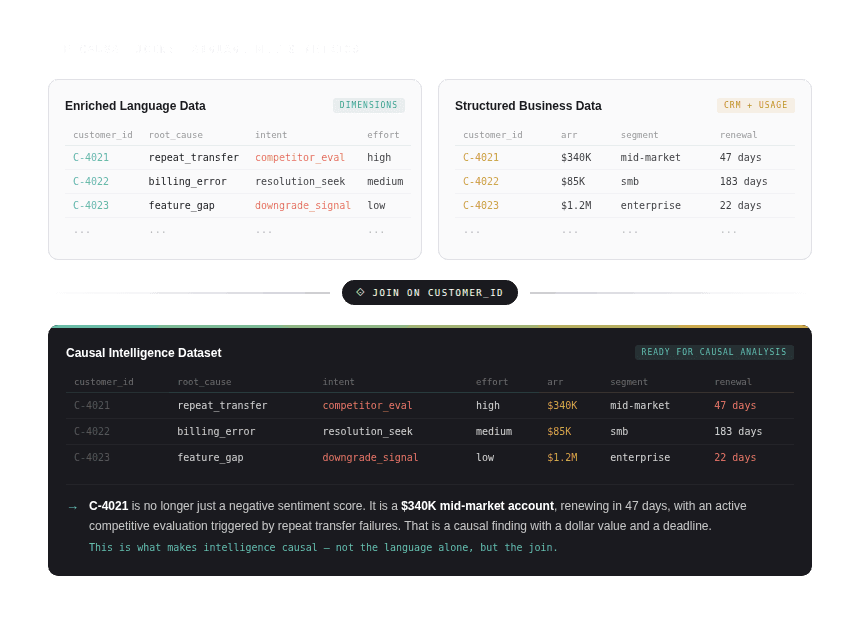
When you know that the customer who said "I'm evaluating your competitor" is a $340K ARR account with a contract renewing in 47 days, that is not a sentiment score. That is a revenue-risk finding with a dollar amount and a deadline.
When you can see that customers who mention "repeat transfers" in the first 60 days churn at 2.8x the baseline rate (n=412, p<0.01), that is not a topic trend. That is a causal mechanism with statistical proof.
The join is what separates "customers are frustrated" from "this specific frustration pattern is costing us $4.7M in annual revenue, concentrated in 34 accounts, fixable with a specific operational change."
3. Statistical rigor.
Not every pattern is causal. Not every correlation survives scrutiny. We apply the same methods used in econometrics and epidemiology to extract causal estimates from observational data.
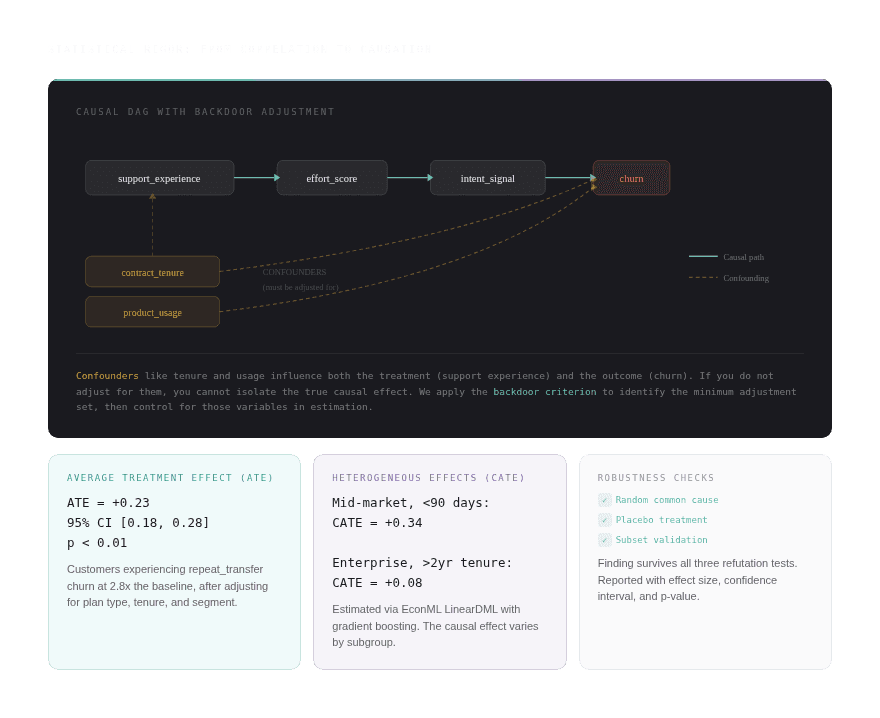
Backdoor adjustment. Given a causal DAG, we identify confounders and adjust for them. If contract_tenure influences both support contact likelihood and churn probability, we control for it to isolate the causal effect of support experience.
Average Treatment Effect (ATE). We estimate the average causal effect of a Dimension on an outcome across the population. "Customers who experience root_cause: repeat_transfer churn at 2.8x the baseline (ATE = +0.23, 95% CI [0.18, 0.28], p < 0.01), after adjusting for plan type, tenure, and segment."
Heterogeneous treatment effects. Using methods like EconML's LinearDML with gradient boosting, we estimate conditional average treatment effects (CATE): "The causal impact of repeat transfers on churn is strongest in mid-market accounts in their first 90 days (CATE = +0.34) and weakest in enterprise accounts with tenure >2 years (CATE = +0.08)."
Robustness checks. Every causal finding is subjected to refutation: random common cause tests, placebo treatment tests, subset validation. If a finding does not survive, it is not reported as causal. We show effect sizes, confidence intervals, and p-values. Not narrative summaries.
The Meaning Layer
Running causal inference once, on one dataset, in a notebook: that is a research project. Running it continuously, at scale, across every customer interaction, with governed and versioned methodology: that is infrastructure.
The Meaning Layer is that infrastructure.
Fivetran solved ingestion. dbt solved transformation. Snowflake solved warehousing. Each layer assumed data arrives as tables and columns. None were designed for transcripts, chat logs, or survey verbatims.
The Meaning Layer is the missing transformation layer for unstructured data. Dimension definitions are versioned like dbt models. Extraction logic is auditable. Outputs are deterministic and reproducible. The schema evolves with the business, with full lineage tracking.
Every month, new conversations flow in, Dimensions update, and the causal dataset refreshes. Reports that took weeks become one-click operations. Q1 findings are directly comparable to Q2 because the methodology is encoded in the system, not in someone's head.
What This Changes
When Causal Intelligence is operational, the questions a company can answer shift from descriptive to mechanistic.
The retention team stops reviewing random cancellation surveys and starts seeing: these are the 23 accounts most likely to churn this quarter, here are the conversation patterns causing it, here is the revenue at risk per account.
The product team stops debating which features to prioritize based on who complained loudest and starts seeing: these four product issues are causally linked to churn, here is the revenue impact of each, fixing issue #1 would reduce mid-market churn by an estimated 15%.
The executive team stops asking "why did metrics move" and starts receiving monthly Causal Intelligence reports: consistent, comparable, statistically validated, traceable to source conversations.
Why Now
Three things converged to make this possible.
Language models can now extract structured variables from text at scale. Processing a transcript dropped from dollars to fractions of a cent. Accuracy is high enough for production use.
Causal inference tooling matured. DoWhy, EconML, and CausalML provide estimation and refutation methods. What was missing was structured language data to feed them.
Enterprises accumulated years of conversation data. Support transcripts, chat logs, call recordings, survey responses, all sitting unused. The raw material already exists. It just has not been structured.
We built the system that connects all three: language models for extraction, the Meaning Layer for persistence and joining, and causal inference for estimation and proof.
The result is Causal Intelligence. Not a new dashboard. Not a better summary. The ability to answer the question every company asks and no tool has been able to answer.
Why?