When the AI Works and When It Doesn't: Lemonade Insurance
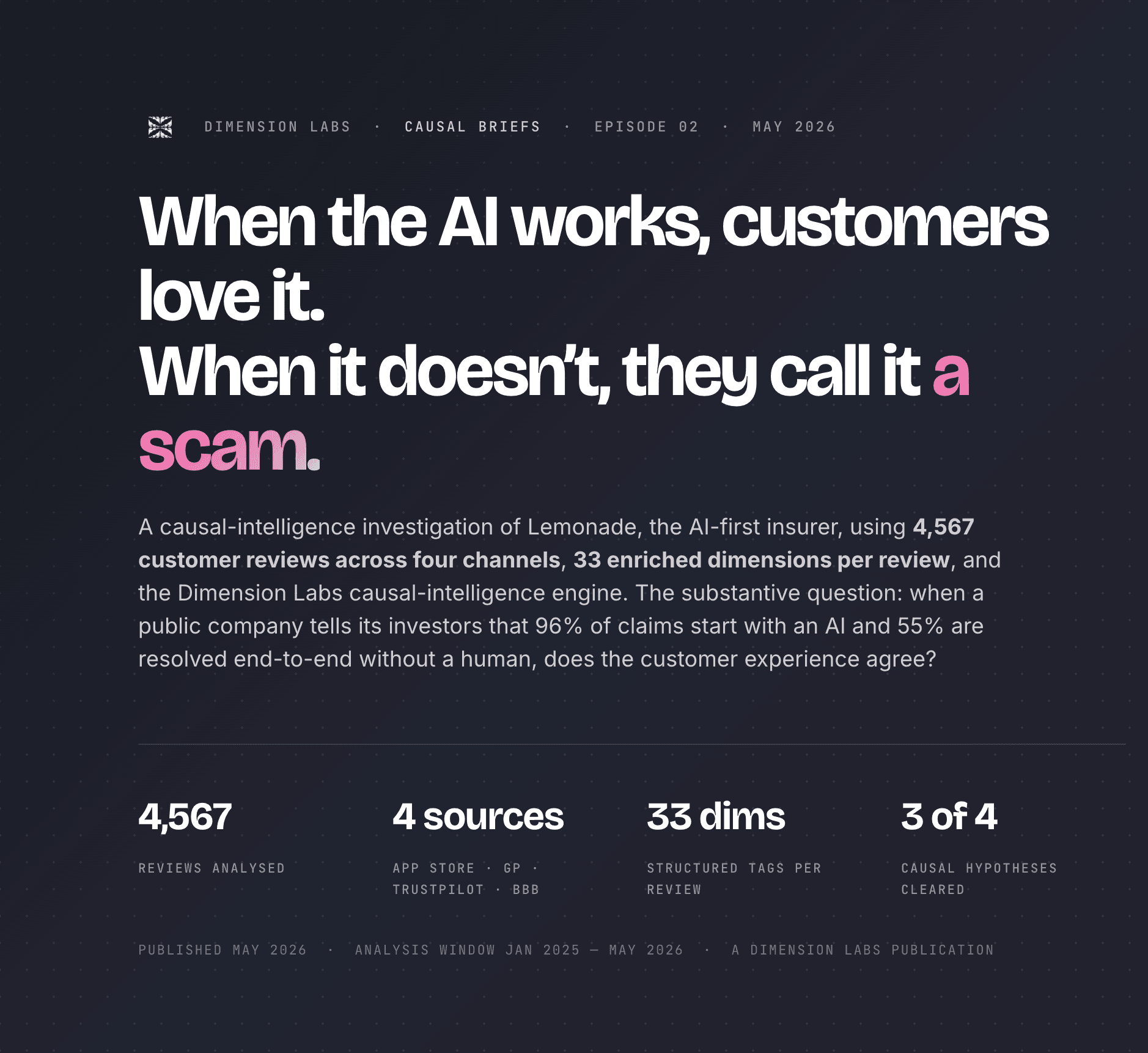
What 4,567 Lemonade Reviews Reveal About the Hidden Cost of AI-First Insurance
Lemonade is one of the most transparent AI-first companies in financial services. Their FY2025 10-K discloses that 96% of first notices of loss are handled by AI, and roughly 55% of claims are resolved end-to-end without a human ever getting involved.
That level of public disclosure makes Lemonade a rare and valuable test case: you can read what the company says about its AI, then read what 4,567 customers say about their experience, and check whether the two stories match.
Dimension Labs did exactly that. Here's what we found.
Key takeaway: Lemonade's AI works extremely well on routine claims — customers describe payouts in minutes and write some of the most enthusiastic reviews in the insurance category. But the same operating model produces a sharp, identifiable downside tail when claims are disputed, escalation fails, or underwriting AI gets it wrong. The customer voice documents that tail months before it shows up in financial metrics.
The Setup: What Makes Lemonade a Falsifiable Target
Most companies don't publish enough operational detail to let you test their AI claims against customer experience. Lemonade does.
What the company discloses:
96% of first notices of loss handled by AI persona "Jim"
~55% of claims fully automated, no human involved
~3M customers, $1.24B in-force premium (Q4 2025)
Annual Dollar Retention dropped from 87% to 85%, attributed to "non-renewal of policies which failed to meet certain underwriting criteria"
FY2025 gross loss ratio improved from 78% (Q1) to 52% (Q4)
What Dimension Labs analyzed:
4,567 reviews across App Store, Google Play, Trustpilot, and Better Business Bureau
Analysis window: January 2025 through May 2026
33 structured dimensions extracted per review — covering claim experience, escalation, policy lifecycle, AI quality, and sentiment
150,711 structured data points total
Three of four pre-registered causal hypotheses cleared the statistical pipeline. One was reported as inconclusive rather than rounded into a finding. Here's what each one showed.
Finding 1: The AI Works — Until You Need a Human
The most consistent signal in the corpus is a clean split: customers whose claims were approved love Lemonade. Customers whose claims were denied are furious with it.
Claim Outcome | Avg. Star Rating | 1★ Count | 5★ Count |
|---|---|---|---|
Approved | 4.69★ | 9 | 1,427 |
Denied | 1.29★ | 332 | 2 |
Pending | 1.58★ | 100 | 2 |
Partial | 2.00★ | 42 | 11 |
No claim | 3.31★ | 880 | 1,261 |
The same AI adjudication engine is producing the corpus's most enthusiastic and most furious reviewers, sorted entirely by whether the claim was paid. This isn't a flaw in the analysis — it's the clearest possible signal about where the operating risk lives.
What intensifies this pattern is claim involvement itself. Reviews involving a claim show a middle-band (2–4 star) share of only 5.18%, vs. 11.03% for no-claim reviews (χ² = 50.36, p < 0.001). Claims don't just change the average — they compress the middle and push customers toward the poles.
Finding 2: Failed Human Escalation Is the Biggest Predictor of an Adverse Review
This is the single most operationally important finding in the analysis.
The strongest predictor of a 1-star review is not the presence of AI. It's the inability to reach a human once something goes wrong.
Customers who report a human was never reached: 89.1% adverse rate (vs. 32.2% baseline)
Customers who specifically sought a phone and couldn't find one: 89.9% adverse rate
Lift over baseline: 2.78×
After adjusting for product line, claim outcome, lifecycle event, and channel — the causal effect of failed human access alone is +29 percentage points (AIPW doubly-robust ATE, 95% CI [+24.5, +33.7], p < 10⁻⁹). All three refutation tests passed.
This is consistent across all four review channels:
Channel | Human Never Reached — Adverse Rate | n |
|---|---|---|
BBB | 100.0% | 24 |
App Store | 88.4% | 69 |
Trustpilot | 89.4% | 170 |
Google Play | 83.7% | 49 |
The Illinois Department of Insurance, in an independent market-conduct examination closed July 2025, documented that 84 of 84 homeowners non-renewals were delivered by email only, and 34 of 34 auto non-renewals were delivered by email only. Customers describing email-only resolution paths in the reviews aren't exaggerating — they're describing what a state regulator independently observed.
The customer-voice implication is narrow and actionable: customers tolerate automation. They don't tolerate being trapped inside it.
Finding 3: The Renewal Trap Is Real — and Management Confirmed It
A persistent cohort of homeowners and auto customers is hitting a harsh exit point driven by AI-based underwriting decisions they can't see, understand, or appeal.
The renewal-trap cohort by lifecycle event:
Non-renewal reviews: avg. 1.07★ (76 of 82 are 1★)
Premium change reviews: avg. 1.27★ (74 of 91 are 1★)
Renewal reviews: avg. 1.55★ (37 of 47 are 1★)
The non-renewal reasons customers describe most frequently are roof age, property condition, water heater age, and location risk zone — exactly the factors Lemonade's AI underwriting system uses. The Illinois DOI exam documented a 116/116 roof-age system bug (Criticism #41) and a 116/116 telematics scoring bug (Criticism #28). The customer voice and the regulator are describing the same operating failures.
The dose-response is monotonic and statistically significant. Each step up the inspection-non-renewal ladder adds +11.8 percentage points to the probability of a 1-star outcome (OLS, 95% CI [+6.1, +17.5], p < 10⁻⁴). All three refutation tests passed.
Lemonade's own Q4 2025 shareholder letter attributes the Annual Dollar Retention drop from 87% to 85% to "non-renewal of policies which failed to meet certain underwriting criteria." The customer voice identifies the mechanism behind that disclosure. The two are describing the same surface from opposite sides.
Finding 4: The Tesla Launch Coincides with a Drop in Auto Sentiment
Lemonade launched Tesla-specific autonomous insurance on January 21, 2026. Using a Difference-in-Differences design comparing auto-product reviews against all other product lines, with validated parallel pre-trends:
Auto sentiment fell from 2.91★ to 2.33★ after the launch
Non-auto sentiment rose from 3.18★ to 3.50★ over the same period
DiD coefficient: −1.05 stars (95% CI [−1.55, −0.54], p < 0.001)
Three caveats apply: the post-period is only ~16 weeks; the Q4 2025 earnings call occurred concurrently; and the auto cohort is small (n=184). The conservative framing is "the Tesla launch or a contemporaneous auto-specific event" caused the drop.
The broader auto signal throughout the window is telematics friction — rate recalibration after month one, opaque trip scoring, driver-vs-passenger ambiguity, device pairing failures. The Illinois DOI exam independently documented a telematics scoring bug affecting 116 of 116 PPA renewals reviewed.
The Paradox: Improving Financials, Persistent Adverse Voice
Here's where it gets analytically interesting.
Lemonade's financial metrics improved steadily across the same window where this adverse customer-voice pattern was building:
Quarter | Gross Loss Ratio | Adj. EBITDA Loss |
|---|---|---|
Q1 2025 | 78% | ~$24M |
Q2 2025 | Improving | Narrowing |
Q3 2025 | Improving | Narrowing |
Q4 2025 | 52% | ~$5M |
These two things — improving financials and persistent adverse voice — aren't incompatible. Here's why they can coexist:
Gross loss ratio is a paid-claims metric. Denied claims, non-renewals, and partial payouts anger customers without worsening the loss ratio. In some cases they improve it.
An AI underwriting system can be substantially better at the median case while remaining brittle in the tail.
The customer voice may be leading the financials by quarters — the same pattern documented in the Duolingo analysis.
Two readings are both defensible. Either the adverse voice is a leading indicator that will eventually pressure retention and CAC. Or the financial improvement is structural and the customer voice represents a brand tax that hasn't yet become a P&L event. The data doesn't adjudicate between them. It surfaces the tension.
What This Means for Any AI-First Operator
The Lemonade case isn't an anti-AI story. The AI is clearly working — 55% of claims resolved end-to-end without a human, customers describing payouts in minutes, some of the highest approval scores in the insurance category.
The specific risk is narrower:
AI systems that handle disputes, denials, and exceptions produce the same downside tail as human systems — but without the escalation path customers expect. The 29-point causal effect of failed human escalation is the most portable finding in this analysis.
Underwriting AI that produces unexplained decisions at the renewal stage creates a trust cohort that maps directly to ADR pressure. Customers don't object to AI making decisions. They object to AI making decisions they can't understand or contest.
The customer voice identifies these failure modes months before they show up in financial metrics. The renewal trap, the escalation gap, and the auto-product friction are all visible in reviews today. Whether they move the loss ratio or retention numbers next quarter is an open question. That they're there is not.
Frequently Asked Questions
What do Lemonade customer reviews reveal about its AI claims model?
Reviews confirm that Lemonade's AI performs well on routine, approved claims — customers frequently describe payouts in minutes and write enthusiastic 5-star reviews. The downside emerges when claims are denied, contested, or when customers need to escalate: denied claims average 1.29★ vs. 4.69★ for approved claims, and customers who report being unable to reach a human are adverse 89.1% of the time.
What is the biggest driver of negative Lemonade reviews?
Failed human escalation is the single strongest predictor of an adverse review — stronger than AI presence, claim denial, or product line. After statistically controlling for confounding factors, the causal effect of being unable to reach a human is +29 percentage points on the probability of an adverse review (p < 10⁻⁹). Customers tolerate automation; they don't tolerate being unable to exit it.
How does Lemonade's customer voice data relate to its financial performance?
Lemonade's gross loss ratio improved from 78% to 52% over the analysis window while adverse customer-voice cohorts (escalation failures, non-renewals, denied claims) remained persistent. These aren't contradictory: denied claims and non-renewals don't worsen a paid-claims metric and can improve it. The question is whether the experience tax documented in the reviews eventually surfaces in retention, CAC, or regulatory exposure — and whether the customer voice is a leading indicator of that pressure.
Does this analysis apply to other insurance carriers or AI-first businesses?
The framework is portable to any company running significant AI on customer-facing decisions. The specific risk profile — AI that handles routine cases well but produces an inaccessible downside tail on exceptions — is most acute when three conditions are present: high automation rates, unexplained decisions at consequential moments (claim denial, policy non-renewal), and no credible human escalation path. Any operator matching that description should be monitoring customer voice for the escalation-gap and decision-opacity signals documented here.
Want to see what your customer conversations are telling you that your dashboards can't? Book a demo with Dimension Labs.
Sources:
Lemonade, Inc., Form 10-K for Fiscal Year 2025. Filed February 25, 2026. SEC EDGAR.
Lemonade, Inc., Q4 2025 Shareholder Letter. Filed February 19, 2026. ir.lemonade.com
Illinois Department of Insurance, Market Conduct Examination of Lemonade Insurance Company (NAIC #16023). Closed July 1, 2025.
Dimension Labs, "Causal Briefs Episode 02: Lemonade" (May 2026). dimensionlabs.ai