What Is an AI Analytics Agent for Customer Conversations?
An AI analytics agent reads every ticket, chat, call, review and survey answer, turns each one into structured fields, and answers questions with numbers. How it differs from dashboards, chatbots and ChatGPT.
An AI analytics agent for customer conversations is software that reads every support ticket, chat, call transcript, review and survey answer a company has, turns each one into structured data, and answers questions about it with numbers. You ask something like "why did cancellations rise in March?" and it returns the topics, the counts and the evidence, drawn from the full set of conversations rather than a sample.
A chatbot talks to customers; an analytics agent works on the record of what customers already said.
Product
Ask a question in plain English and get a chart back
The agent writes the queries, runs them on the structured conversations and answers with a chart.
What it does, step by step
Starts from your question. In plain English, such as why a number moved, with no query to write.
Reads every record. All of the tickets, chats, calls, reviews or survey answers you give it, not the few hundred a person or a single AI prompt can get through.
Turns text into fields. Each conversation gets the same set of typed fields: the topic, whether the issue was resolved, whether the customer mentioned cancelling, which product they used, and so on. We call these fields Dimensions.
Joins them to business data. The fields sit next to revenue, renewals, orders or ratings for the same customer, account or location, so you can ask which issues go with lost revenue.
Tests the answer. Drivers are ranked by their effect on the metric, not by how often they come up.
Delivers the result as a chart, a report, a deck, a dashboard or an alert, and measures the impact as new data arrives.
Product
Every channel read, structured and joined to revenue
Support tickets, surveys, reviews and calls become one table before you ask anything.
How it differs from the tools you already have
| Tool | What it does with customer conversations | Where it stops |
|---|---|---|
| Dashboard or BI tool | Charts the numbers you already have, such as ticket volume or CSAT | The text itself is not data yet, so it cannot say why a number moved |
| Customer-facing chatbot | Answers customers one conversation at a time | It is the source of conversations, not the analysis of them |
| A general AI assistant | Summarizes the text you paste in | It reads what fits in one prompt, can summarize the same data differently each time, and cannot test whether a pattern is real |
| Survey or VoC platform | Collects feedback and tags themes | Themes are counted; joining them to revenue or testing them against an outcome is a separate project |
A worked example: 502,269 app reviews
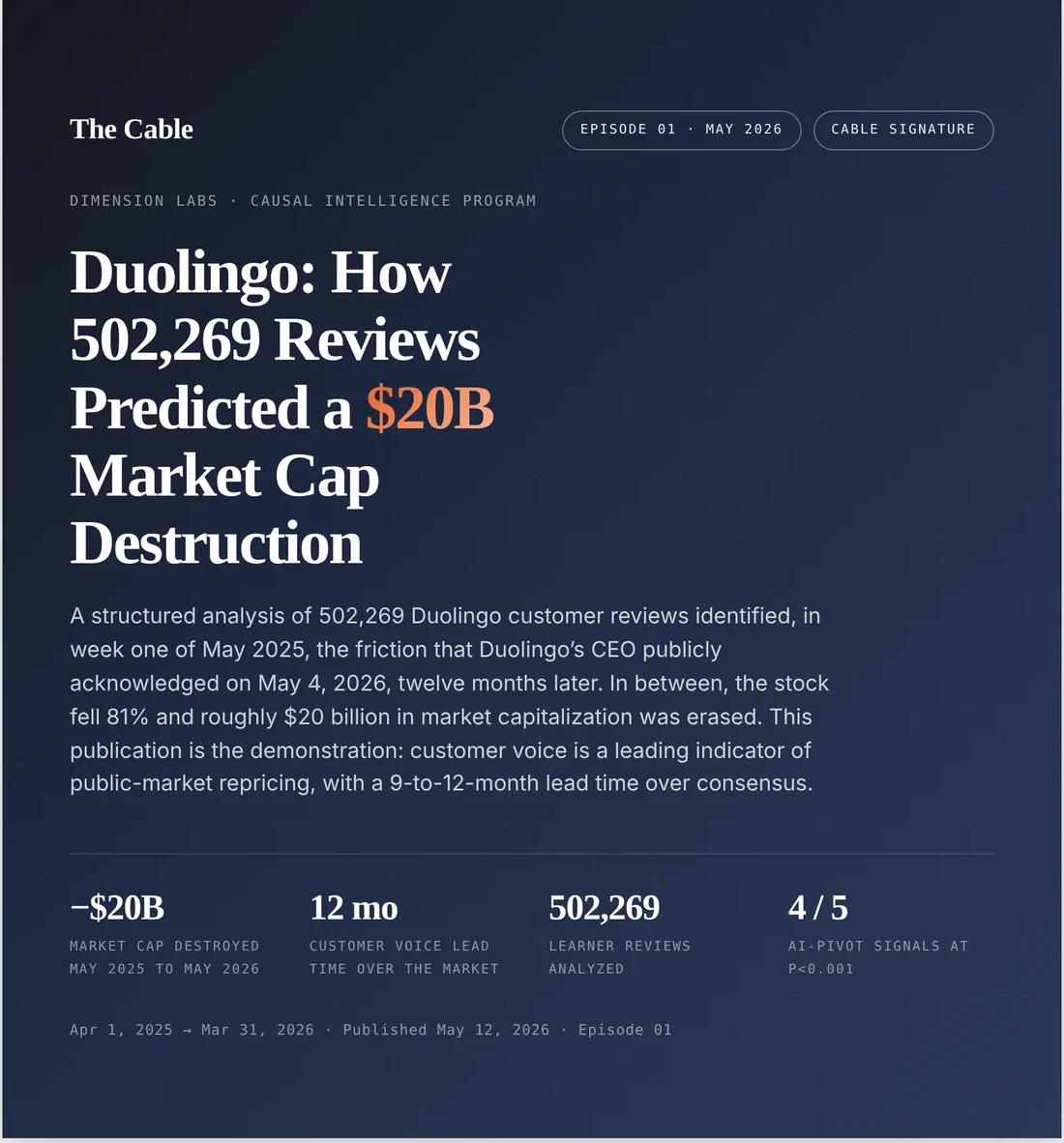
We ran this kind of analysis on 502,269 public reviews of Duolingo. Duolingo announced it was going "AI-first" on April 28, 2025. In the reviews, mentions of AI went from 0.72% to 4.53% of reviews after the announcement, and language about lost trust went from 0.27% to 3.71%, both significant at p < 0.001. Eleven months later, AI mentions were still 2.18 times the level before the announcement.
When Duolingo replaced hearts with an energy system on October 20, 2025, 47.8% of Android reviews in the rollout week were one or two stars, against 9.4% the week before. The full write-up, including how the review signals lined up with the company's later results, is in the Duolingo customer analysis.
Dimension Labs analysis
What changed in 502,269 Duolingo reviews
Public app reviews, structured into fields and compared before and after two product changes.
4.53%
of reviews mentioned AI after the AI-first announcement, up from 0.72%
After Apr 28, 2025
3.71%
of reviews described lost trust, up from 0.27%
After Apr 28, 2025
47.8%
of Android reviews were one or two stars in the energy rollout week, up from 9.4%
Week of Oct 20, 2025
None of this needed access to Duolingo's systems. A company running the same analysis on its own tickets, surveys and app reviews can also join the results to its own subscription and revenue data.
The full analysis
The Duolingo customer analysis
Every review read and structured, then lined up against what the company did and announced.
What to ask before you choose one
Does it read every record, or a sample?
Are the fields the same every time it runs, so this month can be compared with last month?
Can it join conversation data to revenue, retention or operational data?
Does it test whether a pattern is real, or only count it?
Can you check its work against the underlying conversations?
FAQ
Is an AI analytics agent the same as conversation analytics?
Conversation analytics usually means dashboards over call or chat data: volumes, handle times, sentiment. An analytics agent adds the reading and structuring step, so the text becomes data, and answers open questions on top of it. See conversation analytics for more on that term.
Can I just upload my data to ChatGPT instead?
For a few hundred records and a rough read, yes. It stops working when the data is larger than one prompt, when you need the same answer next month, or when you need to show the pattern is real and not a coincidence.
What data does it need?
Any text customers wrote or said: tickets, chat logs, call transcripts, reviews, survey comments. Business data such as revenue or renewals is optional; with it, the answers can be tied to money.
Dimension Labs is an analytics agent for customer language. Plans start at $299 a month, with no demo or sales call; see pricing, or start with one file and ask why a number moved.