Why Gym Members Say They Will Cancel: Evidence From 9,186 Reviews
In 9,186 public reviews of a gym chain, staff problems had the biggest effect on bad ratings, but billing complaints were the ones most likely to say the member was cancelling or warning others away.
A gym chain that wants to cut cancellations usually starts with its exit survey or its star rating. The first tells you what members tick on the way out. The second moves too slowly and, as the data below shows, can be pushed around by a review campaign. Public reviews sit in between. Members write them in their own words, often in the week something went wrong.
We read 9,186 public Google reviews of 33 Planet Fitness clubs in metro Chicago, written between January 2025 and July 2026, and asked two separate questions. What makes a member angry enough to leave a one- or two-star review? And what makes a member say they are done with the gym?
Bad reviews and talk of leaving come from different problems
Front desk and staff problems have the largest measured effect on bad reviews. A review that describes one is 36.3 points more likely to be one or two stars. Billing or cancellation trouble, cleanliness and safety each add about 25 points. The staff estimate has a wide range (26 to 52 points), so its lead is not certain.
Talk of leaving follows a different pattern. The report counted a review as a leaving signal when it says the member is cancelling, will not come back, or is warning others away. Half of the reviews that raise a billing or cancellation problem do. Across all reviews the rate is 1.4%, so billing runs at about 36 times the average. Reviews about staff carry a leaving signal 13% of the time. These rates describe what reviews say; they are not causal estimates.
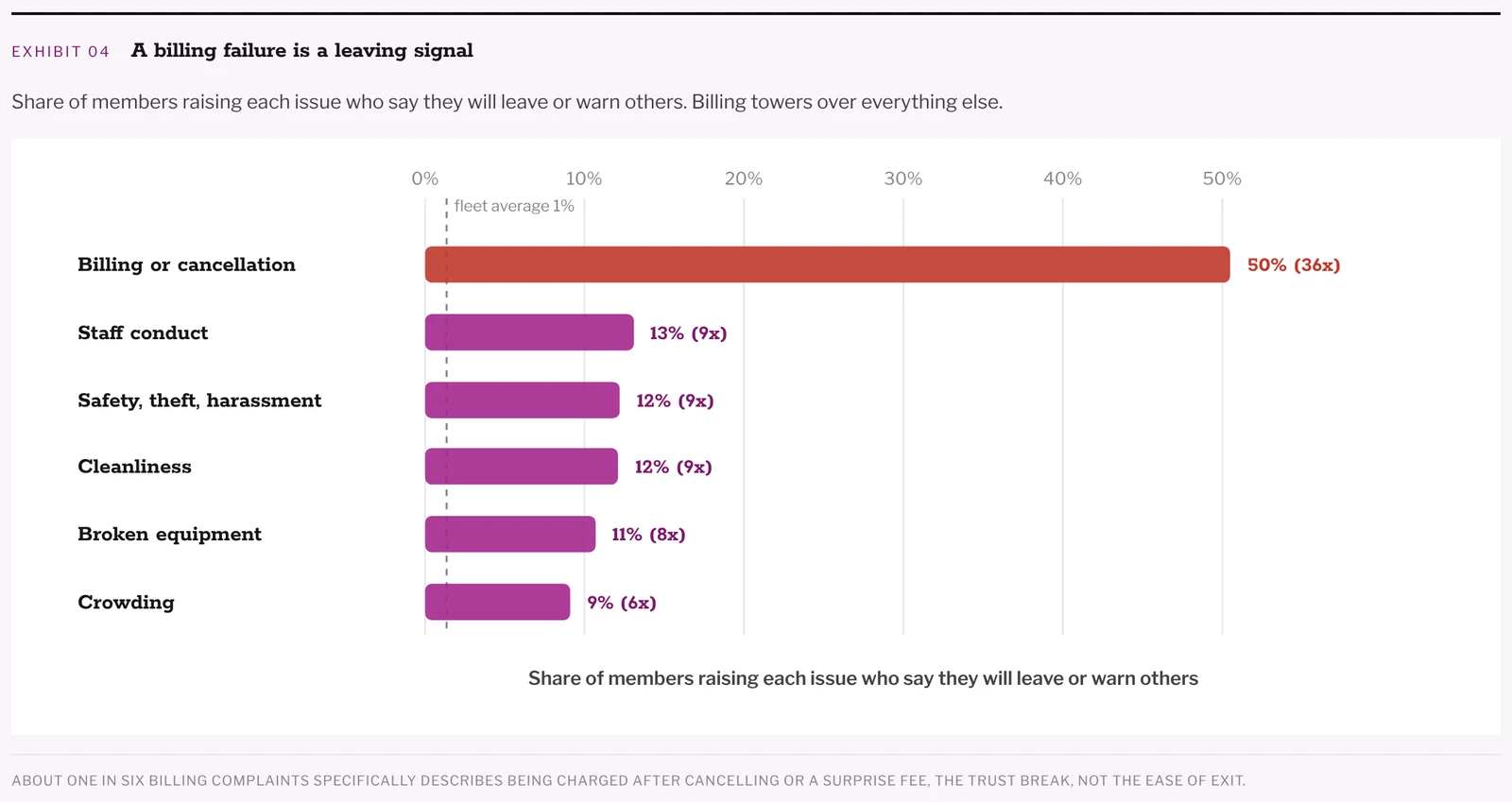
A chain that only works on what moves the star rating would spend its effort on the front desk and could miss the members who were billed after cancelling. The two problems need different owners: staff training for one, the billing system and its rules for the other.
What the billing reviews describe
About one in six billing complaints describes a charge after cancelling or a fee the member did not expect.
The report reads this as a trust problem with the recurring charge, and argues that making cancellation harder would not fix it. That is the report's interpretation of the one-in-six share, not something the reviews prove for every member who leaves.
Urban clubs carry most of the problems
The 33 clubs fall into three types. The ten urban clubs average 3.46 stars over the period and the sixteen outer-suburban clubs 4.84, at the same price. A third of urban reviews are one or two stars. Broken equipment is named in 8.5% of urban reviews and 0.4% of outer-suburban ones.
Some of that gap comes from the reviews rather than the gyms. Between February and October 2025 about 4,903 five-star reviews arrived above the normal rate while the number of unhappy reviews barely moved, which points to a review-generation push rather than better service. Outer-suburban clubs received 84% of all reviews posted in those months. Taking the surge months out narrows the gap: outer-suburban clubs go from 3.1% bad reviews to 7.8%. Urban clubs stay at 33.8%, still about four times higher.
Share of reviews that are one or two stars, by club type
Planet Fitness, 33 Chicago-metro clubs, January 2025 to July 2026. Same brand and price at every club.
The rating Google shows has its own lag. It averages every review a club has ever had (36,279 across these clubs, of which the last eighteen months are about a quarter). At the weakest urban club it shows 4.1 stars, while reviews from the last eighteen months average 2.8.
How a gym chain can find what drives its own cancellations
Treat the star rating as a lagging, gameable number. Use recent reviews only, per club, and check whether a burst of five-star reviews lines up with a review campaign before reading anything into the average.
Tag every review with every problem it names. Billing, staff, cleanliness, safety, equipment and crowding can all appear in one review. A single topic per review loses the second problem.
Measure two outcomes. A one- or two-star review tells you what makes members angry. A stated intent to cancel or warn others tells you what makes them leave. The two lists ranked differently here, and they may in your data too.
Compare clubs of the same type. Urban and suburban clubs have different members, traffic and wear, so a single league table mostly sorts clubs by location.
Join reviews to what you already hold. Reviews only show stated intent. To confirm it, use your own data: cancellation records and reason codes, billing disputes and chargebacks, front-desk tickets and exit surveys, by club and month. If billing complaints in reviews predict cancellations in your records, you have a cause worth fixing first.
The method behind each step is in our posts on which complaints cause bad reviews, causal inference and building a churn risk report. The full gym analysis, with every exhibit, is in the Chicago gym report.
FAQ
Can reviews tell you why members cancel?
They tell you what members say about leaving. That is a lead to check, not proof. In this data, reviews naming a billing or cancellation problem said the member was leaving about half the time. Confirm it against your own cancellation records before you act.
Is the front desk or billing the bigger problem for a gym?
In this analysis, front desk and staff problems had the largest effect on bad reviews, while billing complaints were the most likely to mention leaving. A chain needs both fixed, by different teams.
Why not just use the star rating?
A Google rating is an all-time average, so it moves slowly, and a review campaign can lift it without any change in the gym. Here, one club showed 4.1 stars while its recent reviews averaged 2.8.
Dimension Labs runs this on your own reviews, surveys and tickets, club by club, and joins the results to the numbers you track. See how it works for fitness and recreation, or start with one file.