Which Complaints Cause Bad Reviews? Hotel, Gym and Café Data
In public reviews of a hotel group, a gym chain and a café chain, the most-mentioned complaint was not what drove the one- and two-star reviews. The numbers, and how to check your own.
The usual way to read reviews is to count: which complaint comes up most, then fix that first. This year we ran three sets of public reviews through a causal model (a hotel group, a gym chain and a restaurant chain), and in each one the most-mentioned topic was not the biggest driver of bad reviews. The full reports are linked at the end.
Hotels: front desk complaints are common and barely move ratings
8,504 rated public Google reviews of 45 Marriott-family hotels in Orlando, January 2025 to July 2026.
Front desk and check-in is the most-mentioned topic, in 2,317 reviews (27.2% of comments). Its measured effect on the chance of a one- or two-star review is about two points, and the confidence interval reaches zero.
| Issue named in the review | Reviews | Effect on 1 to 2 star risk |
|---|---|---|
| Front desk or check-in | 2,317 | +2 points (not significant) |
| A dirty room | 849 | +34 points |
| Rude or unprofessional staff | 307 | +44 points |
| A named, praised staff member | 226 | −17 points |
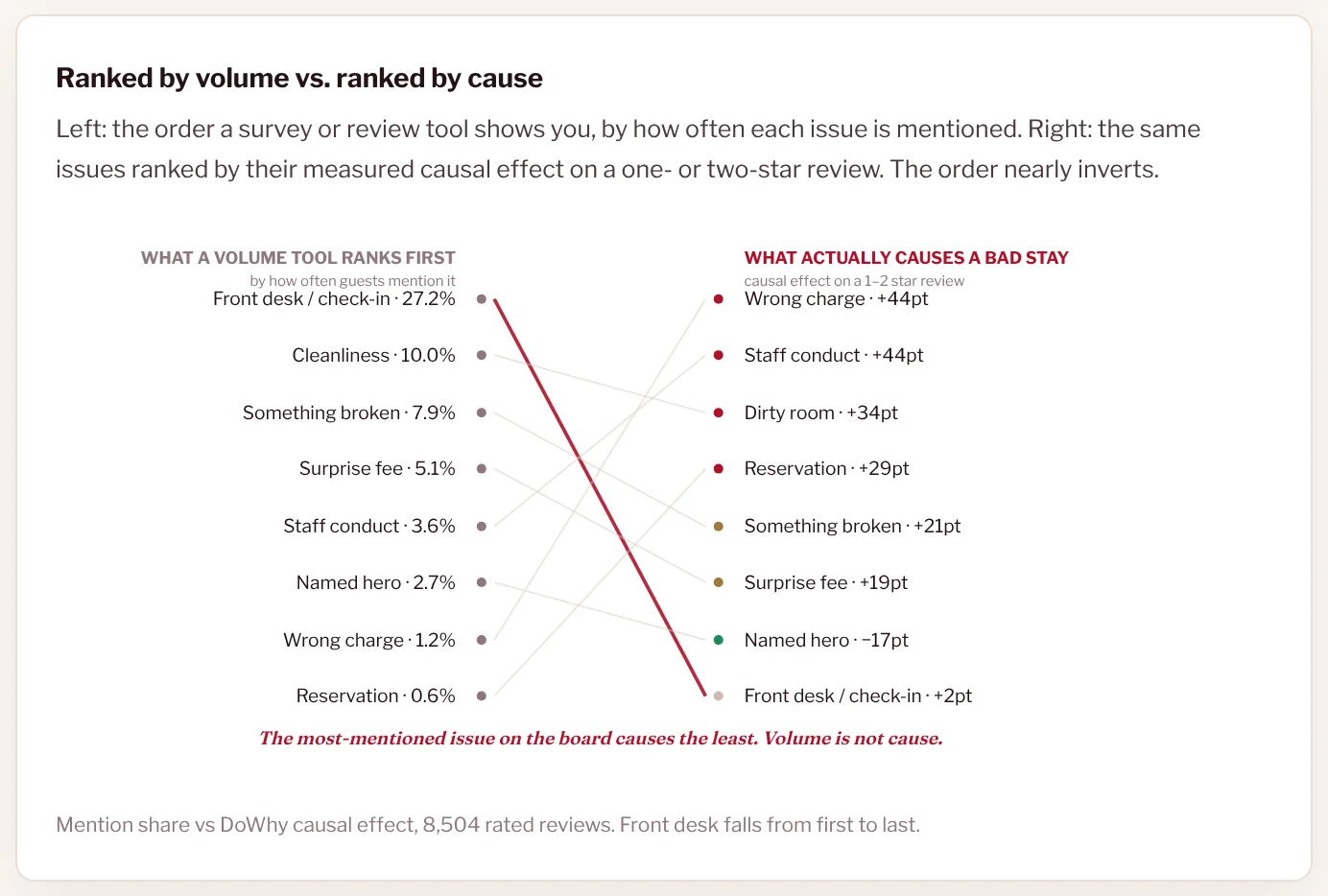
Sorted by count, the lobby is the first thing you would put money into. Sorted by effect, it is staff conduct and housekeeping. A likely reason the desk looks important: angry guests tend to describe the whole stay, and most stays pass the desk.
Gyms: equipment gets the most complaints, staff problems do more damage
9,186 public Google reviews of 33 Planet Fitness clubs in metro Chicago, January 2025 to July 2026.
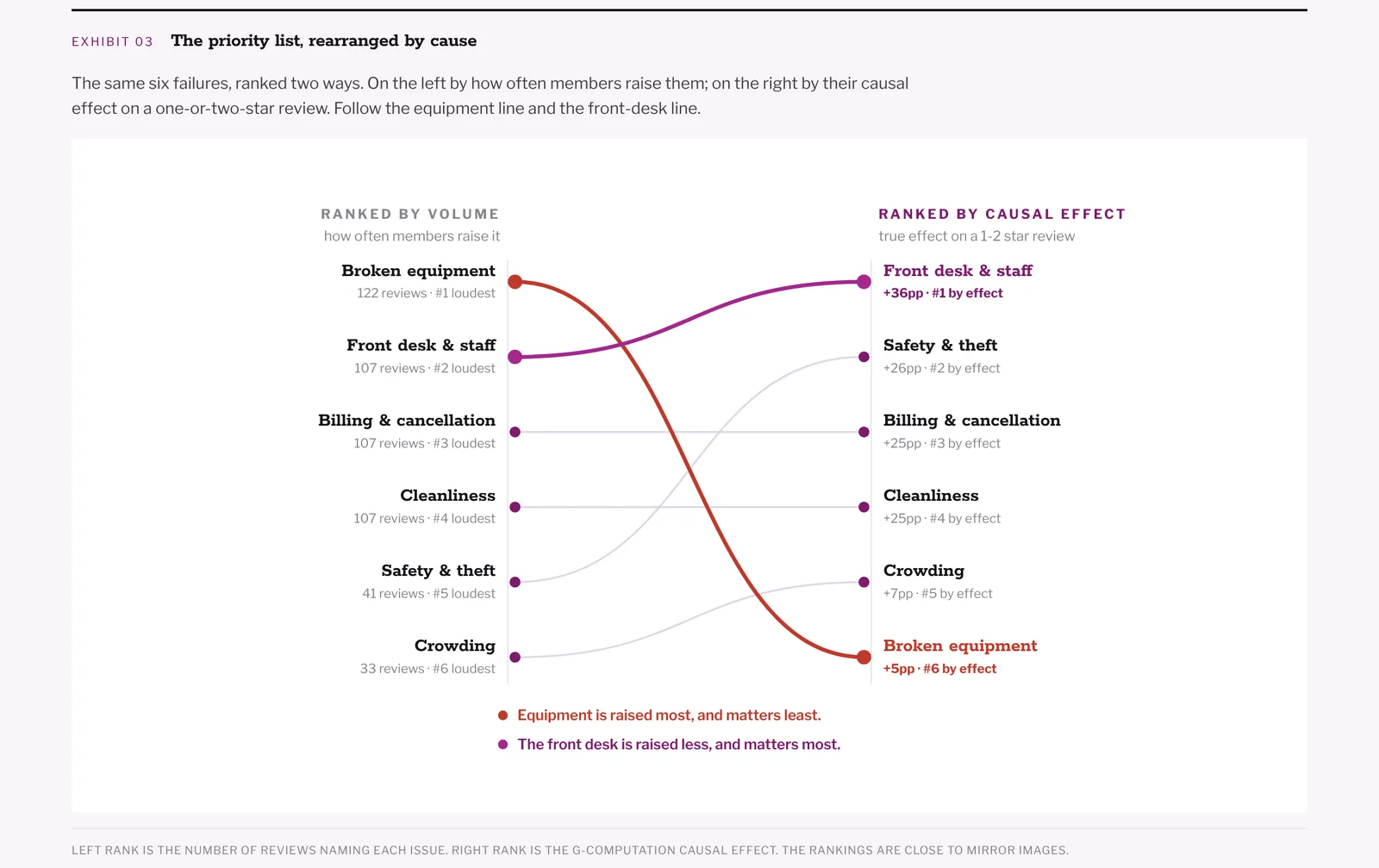
Broken equipment is the complaint members raise most often (122 reviews). It raises the chance of a one- or two-star review by 4.7 points. Front desk and staff problems raise it by 36.3 points, roughly eight times as much on the central estimates (both ranges are wide). Billing or cancellation trouble and cleanliness each add about 25 points.
Failures also stack up within a review. Reviews that named no failure were one or two stars 4.4% of the time, against 66.1% for reviews naming one failure and 80.7% for the 57 that named two.
Restaurants: food comes up most, wrong orders hurt more
1,995 public Google reviews of 24 Panera cafés in the Chicago metro, January 2025 to April 2026.
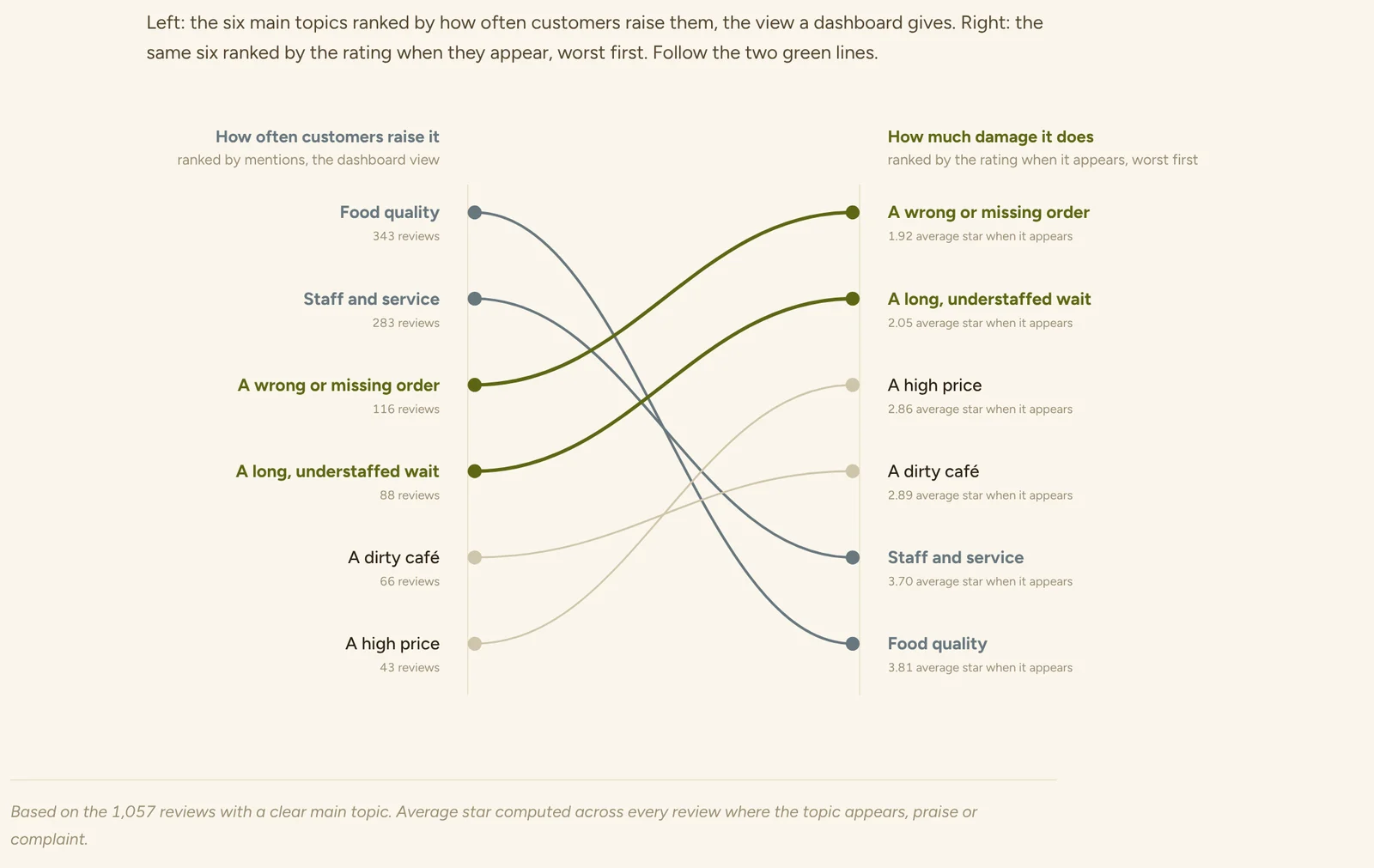
Food quality is the most-mentioned topic, in 343 reviews, and those reviews average 3.81 stars. The report found it draws about as much praise as complaint. A wrong or missing order comes up a third as often, in 116 reviews, and averages 1.92 stars.
On cause, measured across the 1,157 reviews with written text, a rude or absent employee is the largest driver of a bad review, about 33 extra one- or two-star reviews per 100 reviewed visits. A wrong or missing order adds about 20. Ordering through the app or a kiosk shows no real effect, and the report found food and price barely matter.
Why the counts mislead
Counting tells you how common an experience is, not how bad it is when it happens. The parts of a visit everyone touches, like check-in or the food, come up in good reviews as well as bad ones, so their count runs high while their effect stays small. A rude employee or a wrong charge is rarer, and when one appears the review is usually angry.
There is also a measurement trap. A topic can sit next to bad ratings without causing them, because it rides along in long, angry reviews. Simple driver analysis reads that as importance. In the hotel data, standard driver analysis put the front desk second on the fix list; the causal model put it near zero.
How to check your own reviews
Tag every review with every issue it names. One review can complain about a charge and a dirty room at once. A single topic per review hides the second problem. Our semantic clustering guide shows how much a one-bucket approach misses.
Compare like with like. Hold the location, the tier or format, the review length and the time period fixed, so a busy flagship or an angry essay does not do the work for you.
Test each effect before you act on it. Swap in a fake issue (a placebo) and check the effect goes to zero. Rerun on random subsets of the data and check it holds. Each analysis above ran these checks, and each report shows the results.
Then size it. Effect per review times how often it happens tells you, roughly, where the stars are going. A rare, severe failure and a common, mild one can cost about the same.
Public reviews are a good place to start, because you already have them and so do your competitors. Each report linked here was built from reviews anyone can read: the Orlando hotel brief, the Chicago gym analysis and the Chicago café diagnostic. More are in the Artifacts Gallery.
Dimension Labs runs this analysis on your own reviews, surveys or tickets, location by location. Start with one file.